 English
 български
 Deutsch
 Español
 Polski
 Русский
 Română
 Türkçe
 Українська


Koprivshtitsa: Walking Through Bulgaria's Living Museum Town
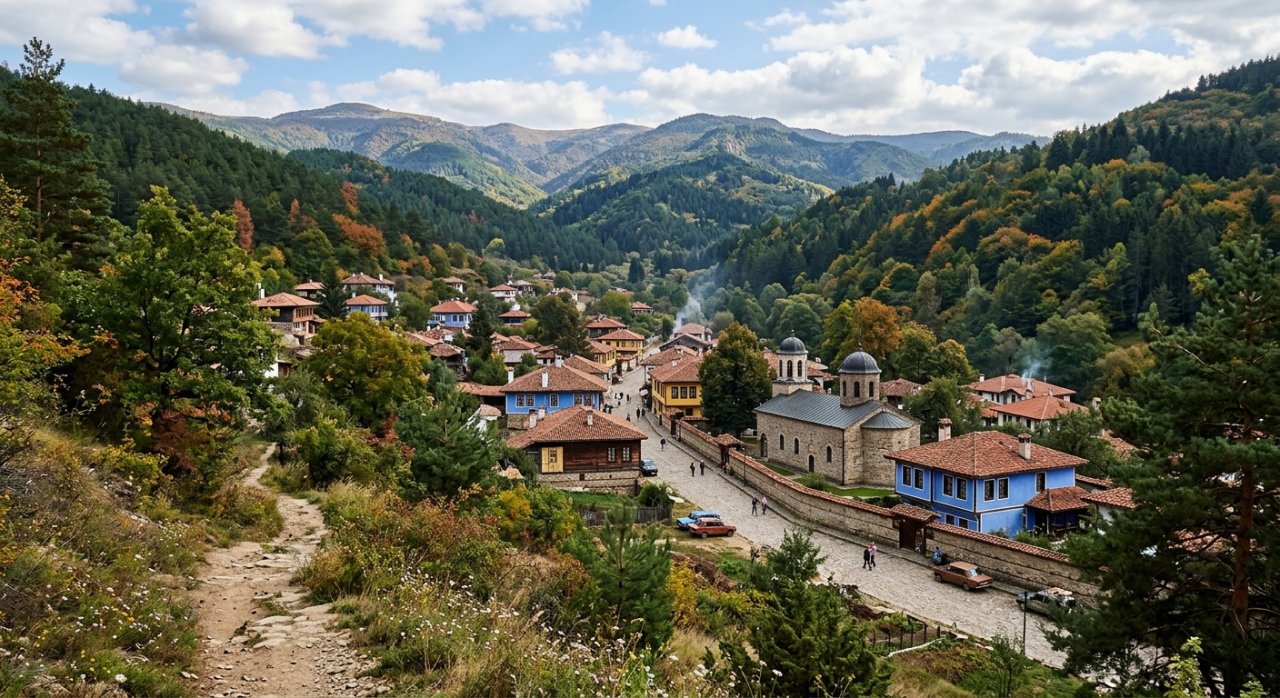
Few places in Bulgaria feel as complete as Koprivshtitsa. Tucked into the Sredna Gora range, this small town is a tangle of cobbled lanes, stone bridges, carved wells and bright National Revival houses with overhanging upper floors. It is also the place where one of the most important episodes in modern Bulgarian history began. If your idea of Bulgaria stops at the seaside, a day or two here will change it.
Why Koprivshtitsa is different
Koprivshtitsa lies in the heart of the Sredna Gora mountains, about 110 km from Sofia and 90 km from Plovdiv. In 1952 it was declared the country's only city-museum, a status that sets it apart from other well-preserved towns. It has been an architectural and historical reserve since 1971 and holds 388 architectural, historical, artistic and ethnographic monuments. In 1978 it was recognised as a national architectural reserve of international importance.
Several legends describe how the settlement began, and they all place its founding at the end of the Second Bulgarian Empire, in the late 14th century. What you see today, however, belongs mostly to a later period. Fires destroyed the town three times between 1793 and 1819, and the current layout dates from after the third and most destructive blaze. The houses that rose afterwards are tied to the Bulgarian National Revival of the 18th and 19th centuries, and they are the reason people visit.
The April Uprising: the story behind the town
You cannot understand Koprivshtitsa without the April Uprising of 1876. The town was the home of Todor Kableshkov, head of the local revolutionary committee. On 20 April 1876 he sent what became known as the "Bloody Letter", a call to rebellion addressed to leaders in Panagyurishte and other settlements. Its text survives in Zahari Stoyanov's Memoirs of the Bulgarian Uprisings.
According to Bulgarian National Radio's account, an Ottoman official, Neceb Aga, arrived from Plovdiv and ordered several people, including Kableshkov, to be imprisoned. Kableshkov responded to the decision taken by the Council of Oborishte by gathering armed men, who attacked the konak, the local administrative building. The letter itself describes a flag flying over the konak, gunfire and church bells ringing. The uprising began earlier than planned, was poorly coordinated, and was soon suppressed.
Its consequences were far greater than its military result. Ottoman atrocities against civilians drew European intervention, which led to the Russo-Turkish War and, in 1878, to the first free Bulgarian lands: the Principality of Bulgaria and the autonomous region of Eastern Rumelia. In everyday Bulgarian speech, "Bloody Letter" has even become an expression for determination, action and keeping your word.
The houses you should not miss
Koprivshtitsa's museum houses show how wealthy Revival-era families lived, and each has its own character. These are the main ones:
- Oslekov House (1856): richly decorated walls and columns, lacework and clothing.
- Lyutova House (1854): felt objects, murals, woodcarvings and a rosewater fountain.
- Todor Kableshkov House (1845): built in the Plovdiv style and the birthplace of the revolutionary.
- Dimcho Debelyanov House (1830): the birthplace of the poet, with a courtyard sculpture of a waiting mother.
- Georgi Benkovski House (1831): renovated in 1966 and home to his cherry-wood cannon.
- Lyuben Karavelov House: a national architectural monument with a pear tree planted in 1854.
A combined six-museum adult ticket was listed at about €10 and a single-museum ticket at about €5 on one visitor guide. Student, pensioner and family tickets, guided talks and audio guides exist too, but prices were not given, so confirm them locally.
Churches, wells and bridges
Between museum visits, wander without a plan. The Church of the Assumption of the Blessed Virgin (1817) has woodwork and icons, and St. Nicholas Cathedral (1842–1843) has biblical murals. The town also has more than 40 wells, many decorated with carved stars, sea creatures and flowers. The Benevska and Chalakova wells are among the oldest.
Stone bridges arch over the streams that feed the Topolnitsa River. The best known is Kalachev Bridge, nicknamed the "First Shot Bridge" for its link to the first shot of the uprising. It is a small, photogenic spot and a natural place to pause on a walking route.
Beyond the old town: forests and trails
Koprivshtitsa is not only about architecture. The Bogdan Preserve, protected since 1972, includes beech forest, Clover Field and Bogdan Peak, at 1,604 metres the highest point of the Sredna Gora. Donkin Forest, protected since 1979, is home to the Eastern Imperial Eagle. There are eleven marked trails, averaging three to four hours, which start at the Bogdan Tourist Center. Guides there speak Bulgarian, English and French.
If you only have a day, keep to the town. If you stay overnight, a half-day walk in the forest gives a welcome contrast to the museum rooms.
Koprivshtitsa among Bulgaria's other Revival towns
Koprivshtitsa is not the only Bulgarian town shaped by the National Revival. Its early development is described as similar to that of Zheravna, Tryavna, Samokov, Etropole and Tetevan, which is a useful tip if you are planning a longer trip: each of these towns offers its own version of the same period, and visiting two of them lets you compare. What makes Koprivshtitsa special is the scale of the protection. A museum directorate was established in 1956, only a few years after the town became a city-museum. Visit at a slow pace, and the town rewards you far more than a quick photo stop would.
Festivals and the best time to visit
One local event is the Debelyanov Evening, held every August in the courtyard of the poet's house, where poets and musicians perform his work.
The museums operate all year, with shorter hours in winter and longer hours in summer. Some sites close on Mondays and others on Tuesdays, so check the schedule before travelling. One site, Tepavitsa, has summer-only hours. Winter brings shorter days and possible ice on the cobbles. The area is often windy, so bring a warm layer whatever the season.
How to get there
A car is the easiest way to reach Koprivshtitsa for a day trip from Sofia or Plovdiv. Trains run from Sofia, but the station is outside the town, so you will need an onward taxi, bus or shuttle. Organised day tours from both cities also exist if you prefer not to drive.
How long to stay and what to wear
Allow two to three hours for a short visit, or four to six hours for the full museum circuit. If you plan to see three or more museums, the combined ticket is better value. The streets are cobbled and some houses have steps, so wear flat, comfortable shoes. The site is not fully step-free, which matters for visitors with limited mobility.
For food, hotels, guesthouses and restaurants in town serve traditional Bulgarian dishes. Book ahead in busy periods. If you want local help, the Tourism Council Association and the Directorate of Museums are both based on 20th April Square, and the directorate lists museum opening hours on its website.
A one-day plan
Arrive by mid-morning and begin in the town centre. Visit Kableshkov House first, because the uprising explains everything else you will see, then Oslekov House for its decoration. Eat a traditional lunch in town. After lunch, cross a few of the stone bridges, stop at one or two wells, and visit the Lyutova or Debelyanov houses depending on opening hours. Leave time at the end for the churches and a quiet walk in the lanes.
Keep exploring Bulgaria
Looking for places to stay or local guides in Bulgaria? Browse the listings on RavdaBG.com, and read our coast guides for a different side of the country.
Frequently Asked Questions
Newsletter
Join our subscribers list to get the latest news, updates and special offers directly in your inbox