 English
 български
 Deutsch
 Español
 Polski
 Русский
 Română
 Türkçe
 Українська


Bulgaria Tourism August 2026: Fewer Arrivals but Higher Revenue, and What It Means for the Coast
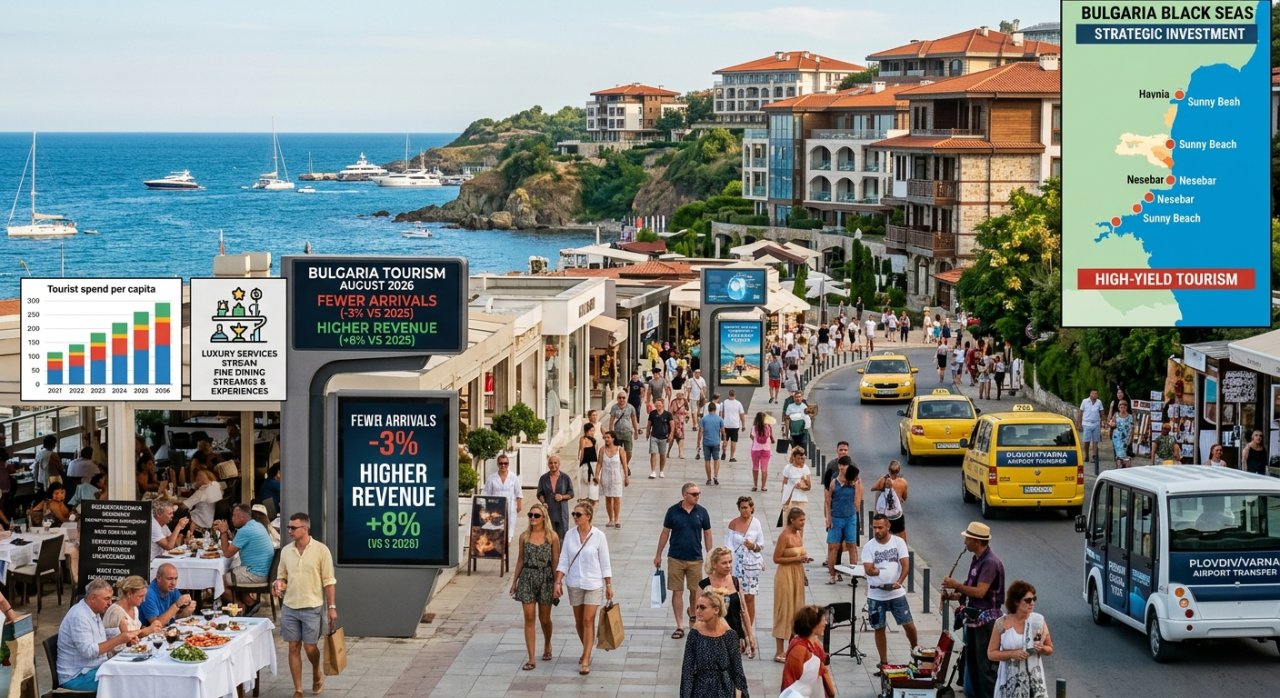
Bulgaria tourism August 2026 followed the pattern of the whole summer: fewer guests, more money. Figures from the National Statistical Institute (NSI), reported by The Sofia Globe on 12 October 2026, show 1,640,151 arrivals in accommodation establishments, down 0.8% on August 2025, while accommodation revenue rose 13.3% to €384.5 million. This report sets out what is confirmed, what is not, and what it means for travellers and hosts on the Black Sea coast.
What the NSI reported for August 2026
The NSI published the August data on 12 October 2026, according to The Sofia Globe. Compared with August 2025:
- Total arrivals: 1,640,151, down 0.8%.
- Arrivals by non-residents: down 2.2%.
- Arrivals by Bulgarian residents: up 1%.
- Total accommodation revenue: €384.5 million, up 13.3%.
- Revenue from non-residents: €270.5 million; the remainder came from residents.
- Bed-place occupancy: 56.5%, down 1.3 percentage points.
Occupancy differed sharply by category. Four- and five-star places stood at 72%, three-star at 48.6% and one- and two-star at 33.1%.
The Sofia Globe report carries only national figures. I found no published August breakdown for Burgas Province in the sources reviewed, so I cannot say how the Black Sea coast specifically performed in August.
Where this sits in the summer picture
August was the third month in a row with the same shape. Here is what earlier months showed, with the source for each.
For July 2026, the Bulgarian News Agency (BTA) reported on 11 September that overnight stays fell 5.4% to 5.768 million, while revenue from overnight stays rose 11.4% to €346.4 million. Foreign guests fell 5.4% to 790,000 and stayed an average of 4.6 nights. Bed occupancy was 53.3%, down 2.5%.
BTA also reported that Burgas Region took €176.7 million of July revenue, about half the national total, including €125.6 million from foreign visitors. That is the clearest official sign of how central the southern coast is to the national result.
For June 2026, Travel And Tour World, citing NSI data on 7 October, reported overnight stays down 3.6% and accommodation revenue up 13.6% to about €197.97 million. It put Burgas province in June at about €87.5 million in revenue. That is a secondary report of NSI data, so check the NSI release if you need the exact figure.
The Sofia Globe noted the same fewer-arrivals, higher-revenue pattern in June and July.
What the minister has said about the season
Tourism Minister Ilin Dimitrov has been consistent in his messaging. On 17 August, speaking in Varna, he said the sector was nearly back to last summer's levels and blamed a rocky start on problems in the German market. He said tourist registrations were about 1.61 million in July against 1.65 million a year earlier, and that package prices and length of stay need review. His summary, as reported by Bulgarian National Radio: "Certainly, we cannot speak of a catastrophe, but there is no reason for great optimism either."
Note that the minister's 1.61 million July figure and the NSI-based 1.456 million guests reported by BTA are different numbers, and the sources do not explain why. Do not compare them directly; they may use different definitions.
On 5 September, BTA reported he expected results close to last year's, within 1 to 2% either way. He said May and June were weaker mainly because part of the German market was absent, with about 200,000 German air seats lost after problems between two major market players, and that the shortfall was later offset.
On 27 September, speaking from Varna, he said final 2026 season figures were not yet available and results were expected to be close to 2025.
Why revenue can rise while visitors fall
The NSI numbers measure revenue and arrivals, not prices, so they do not by themselves prove that rooms became more expensive. Several things could produce the pattern, and the sources do not say which dominates.
Possible explanations include higher nightly rates, a shift toward higher-category hotels, or a different mix of guests. The data do offer some support for the category angle: in July, four- and five-star establishments accounted for 78.5% of foreign visitors' overnight stays, and in August they had the highest occupancy at 72%. In June, TTW reported that four- and five-star places made up 79.9% of foreign overnight stays.
The minister himself said results were good where price increases were reasonable, and that a fuller assessment of prices, average rates and overnight stays was expected in October. That fuller analysis was not yet published in the sources I could find, so treat any claim about exact price rises as unverified.
What it means for travellers
For a visitor choosing a late-season trip, the data point to two practical conclusions. First, lower-category places have much more spare capacity: one- and two-star occupancy was 33.1% in August, according to the NSI figures. That does not guarantee discounts, but it suggests room to negotiate or choose.
Second, the sector's own leaders are pushing hard to extend the season. On 4 September, in Nessebar, the minister said September could be strong if the weather held and urged Bulgarians to visit the coast then, when offers become more attractive. He also described a planned connectivity and promotion fund, saying "This will completely change the way the season operates."
Nothing in these reports guarantees a particular price or availability in October. If you are travelling now, check your accommodation's current opening and heating arrangements directly.
What it means for hosts and owners
For hosts around Ravda and Nessebar, the lesson is not that demand collapsed. Arrivals fell by less than one percent in August and revenue grew by double digits nationally. The weak spot is foreign arrivals, down 2.2%, while resident arrivals rose 1%.
Occupancy is the pressure point. At 56.5% overall, and 33.1% in the lowest categories, there is plenty of unsold supply. Hosts competing on price alone face a difficult winter; clear listings, accurate photos and honest descriptions are cheaper levers than discounting.
The minister also said that in the planned changes half of tourism-tax revenue would go to promotion and events related to air connectivity, intended to help extend the season. The sources give no bill number or timeline, so this is a plan rather than law.
What to watch next
Several items are still pending according to the sources.
- The full 2026 season assessment the ministry has said it expects, covering prices, average rates and overnight stays.
- September 2026 NSI data, which the pattern suggests will arrive in early November. That timing is an inference from the August and July release dates of 12 October and 11 September, not an announced date.
- Any breakdown for Burgas Region for August, which was not in the reports I reviewed.
Check the NSI site directly for the primary tables, because newspaper summaries leave out detail.
Plan your own stay with RavdaBG
If you are planning an autumn, winter or 2027 stay on the coast, browse current listings in Ravda, Nessebar and Sunny Beach on RavdaBG.com. Hosts can use the same platform to reach guests early. Visit RavdaBG.com to compare options and contact owners directly.
Frequently Asked Questions
Newsletter
Join our subscribers list to get the latest news, updates and special offers directly in your inbox